Global Electric Vehicle Market to Reach USD 4,925.91 Billion by 2032 as Light-Duty EVs Reshape Automotive Scale, Technology Mix, and OEM Power Structures: MMR Statistics
PUNE, India, Feb. 2, 2026 /PRNewswire/ -- The Global Electric Vehicle Market has entered a decisive scale-up phase, transitioning from policy-led adoption to execution-driven industrial transformation. According to MMR Statistics, the global electric vehicle market was valued at USD 1,304.64 Billion in 2025 and is projected to reach USD 4,925.91 Billion by 2032, expanding at a CAGR of 20.9% during the forecast period.
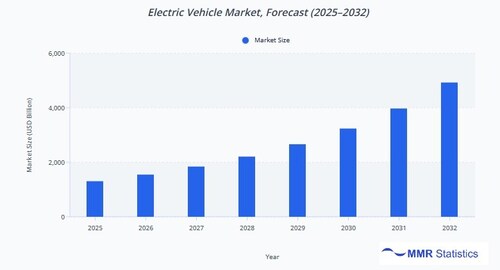
This growth is not incremental. It signals a structural reordering of the global automotive value chain, where light-duty EV penetration, BEV–PHEV technology mix, and OEM execution capability are redefining competitive advantage across China, Europe, the United States, India, and emerging markets.
Get Full PDF Sample Copy of Report: (Including Full TOC, List of Tables & Figures, Chart) @ https://www.mmrstatistics.com/reports/400646/electric-vehicle-market/contact?type=sample
Why This Market Demands CXO Attention Now
The EV transition has crossed the experimentation threshold. With light-duty electric vehicles approaching one-fourth of new vehicle sales globally, the industry is no longer debating adoption—it is confronting scale economics, cost control, and portfolio discipline.
For CEOs and investors, the core question has shifted from "How fast will EVs grow?" to
"Who is structurally positioned to capture value as EVs become mainstream?"
Executive Snapshot — Global Light-Duty EV Market (2025)
Metric | Strategic Interpretation |
Market Size (2025) | USD 1.30 Trillion |
Forecast (2032) | USD 4.93 Trillion |
CAGR (2025–2032) | 20.9 % |
EV Share of New LDV Sales | ~23% globally |
Dominant Technology | BEVs (~65% of EV sales) |
Production Concentration | China (~70%+ of global output) |
Competitive Reality | Scale, speed, and localization define winners |
EVs are no longer an alternative drivetrain; they are becoming the core automotive growth engine.
Global EV Volume Momentum: Scale Is Accelerating Faster Than Value
While market value highlights monetization, volume growth reveals where structural leadership is being established. In 2025, global electric light-duty vehicle sales crossed ~17–18 million units, nearly doubling compared to 2022 levels.
- China accounts for ~60% of global EV unit sales, driven by mass-market BEVs, aggressive domestic OEM pricing, and manufacturing scale
- Europe contributes ~20% of global EV volumes, supported by fleet electrification mandates and regulatory enforcement
- United States represents ~10–12% of EV volumes, constrained by pricing dispersion and uneven charging infrastructure
- India and emerging Asia remain below 5% in volume share but exhibit the fastest year-on-year growth trajectories
Future EV leadership will be determined by who wins volume scale first—not who monetizes premium models early.
Light-Duty EV Penetration: Four Markets, Four Realities
Between 2020 and 2025, EV adoption diverged sharply across major auto economies:
- China now anchors global EV scale, with nearly half of new LDVs sold as EVs, supported by domestic OEM dominance and cost-down manufacturing.
- Europe has crossed a regulatory-driven inflection point, with EVs accounting for over one-fifth of new vehicle sales, driven by fleet electrification and emissions enforcement.
- United States shows selective adoption, constrained by pricing dispersion, charging gaps, and consumer segmentation.
- India remains early-stage but strategically important, with EV adoption concentrated in compact, value-oriented segments.
Immediate Delivery Available | Buy this Research Report (Insights, Charts, Tables, Figures and More) - https://www.mmrstatistics.com/checkout/reports/400646/contact
EV adoption is no longer linear or uniform—it follows local economics, infrastructure readiness, and OEM portfolio alignment.
Infrastructure & Policy Execution: Why Some Markets Pull Ahead
EV adoption increasingly follows infrastructure readiness and execution speed, not consumer intent alone.
- China leads with dense fast-charging networks, battery supply localization, and city-level EV mandates
- Europe benefits from fleet electrification rules, public charging subsidies, and OEM compliance urgency
- United States faces adoption friction as charging rollout lags vehicle penetration outside select states
- India is prioritizing two- and three-wheeler electrification as a gateway to broader passenger EV scale
EV penetration follows charging density, grid readiness, and policy execution—not just affordability.
Technology Mix: BEVs Consolidate, PHEVs Remain Tactical
Across global light-duty EV sales in 2025:
- Battery Electric Vehicles (BEVs) represent ~65% of total EV sales, consolidating their position as the dominant technology.
- Plug-in Hybrid EVs (PHEVs) retain relevance in markets where charging infrastructure, range anxiety, or price sensitivity limit full BEV adoption.
China's BEV share has rebounded strongly, while the US and Europe maintain a mixed technology strategy. India remains predominantly BEV-led.
OEMs misaligned with regional technology economics face portfolio inefficiency and delayed ROI.
Model Concentration: Scale Is Being Captured, Not Distributed
EV sales are increasingly concentrated around a limited number of high-volume platforms:
- In the US, the top 10 BEV models account for over two-thirds of total BEV sales
- In China and Europe, top models still command one-third or more of EV volumes
- In emerging markets, concentration is even higher, driven by affordability and platform reuse
EV scale is being won through platform concentration, not model proliferation.
Segment Economics: Where EV Economics Actually Work
- Passenger LDVs dominate EV volumes, but fleet and shared mobility segments show faster adoption due to predictable total cost of ownership
- Entry and mass-market EVs drive scale in China and emerging markets
- Premium EVs remain value-heavy but volume-constrained in Europe and the US
- Commercial LDVs are emerging as the next electrification frontier
EV success is segment-specific—one-size-fits-all portfolios fail.
Production vs Sales Imbalance: China's Structural Advantage
In 2025, global EV production and sales flows reveal a clear imbalance:
- China controls over 70% of global EV production
- Europe and the US remain sales-heavy but production-constrained
- Emerging markets are increasingly dependent on imported platforms or localized assembly
Access the full consulting-grade Global Electric Vehicle Market analysis (2025–2032): https://www.mmrstatistics.com/reports/400646/electric-vehicle-market
Risk lens:
This concentration introduces geopolitical, trade, and supply-chain exposure for global OEMs and suppliers.
Emerging Markets: Volume Today, Strategic Optionality Tomorrow
Markets such as Brazil, Thailand, Vietnam, Mexico, and South Africa are witnessing early EV uptake—primarily in fleet, urban, and compact segments.
While current volumes remain modest, these markets represent long-term demand optionality, particularly as cost-competitive BEVs and localized manufacturing expand.
Competitive Landscape: Execution Discipline Separates Winners from Laggards
The global EV market is increasingly polarized:
- Scale Leaders: OEMs with cost leadership, rapid model refresh, and localized supply chains. BYD, SAIC, Tesla — platform reuse, battery integration, pricing power
- Technology Leaders: Players with strong BEV platforms and software integration. Tesla, Hyundai-Kia, select European OEMs — strong platforms, margin pressure
- Challenged OEMs: Legacy manufacturers with fragmented EV portfolios and slow execution. Fragmented portfolios, slow localization, rising capital strain.
Brand strength alone no longer guarantees EV success—industrial execution and speed now determine survival.
Value Migration & Strategic Risk
- Value is shifting from ICE platforms to EV architectures, batteries, and software
- OEMs without scale face margin compression and capital inefficiency
- Delayed localization increases exposure to cost volatility and policy risk
Organizations treating EVs as an extension of legacy portfolios risk structural erosion of competitiveness.
Analyst Perspective
"The global EV market has moved beyond ambition into execution," said a Senior Analyst at MMR Statistics.
"From 2025 onward, competitive advantage will be defined by how effectively manufacturers align scale, technology mix, and regional economics—not by headline electrification targets."
Why This Research Drives Decisions
The Global Electric Vehicle Market report by MMR Statistics provides decision-ready intelligence on:
- Light-duty EV sales share and technology mix
- OEM and model-level concentration dynamics
- Regional production–sales asymmetry
- Emerging-market opportunity and risk
- Strategic positioning across BEVs and PHEVs
Designed for OEMs, suppliers, investors, and policymakers, the analysis goes beyond market sizing to explain where value is accumulating—and where execution risk is rising.
Most EV reports track adoption. This analysis tracks who captures value, who absorbs risk, and who loses relevance as EVs scale
Related Reports:
Global Electric Vehicle Charging Stations Market - https://www.mmrstatistics.com/reports/595775/global-electric-vehicle-charging-stations-market
Unmanned Aerial Vehicle Market - https://www.mmrstatistics.com/reports/142506/unmanned-aerial-vehicle-market
Smart Sensor Market - https://www.mmrstatistics.com/reports/440529/smart-sensor-market
Global Commercial Vehicles Market - https://www.mmrstatistics.com/reports/754754/global-commercial-vehicles-market
Substation Maintenance Market - https://www.mmrstatistics.com/reports/837784/substation-maintenance-market
About Us :
MMR Statistics (https://www.mmrstatistics.com) has been empowering organizations with data-driven insights since 2015. We deliver industry intelligence, bespoke research, and strategic advisory support tailored to help our clients achieve sustainable growth.
Contact:
Lumawant Godage
Visit Our Web Site : https://www.mmrstatistics.com/
Email: sales@mmrstatistics.com
Phone :+91 9607365656
Global Office :
Navale IT park Phase 3
Pune-Bangalore Highway,
Narhe, Pune, Maharashtra 411041, India
Photo - https://mma.prnewswire.com/media/2874800/MMR_Statistics.jpg






Share this article