73% of B2B Buyers Use AI Tools in Purchase Research, Multi-Source Analysis Finds
New analysis of six independent studies covering 680 million citations, 2,961 research sessions, and 1.96 million browsing sessions finds AI search converts at 5.1x the rate of Google organic — but 78% of marketers have no strategy for AI visibility.
SEATTLE, April 3, 2026 /PRNewswire/ -- Loganix, a performance SEO and link building services provider, today released findings from its 2026 B2B AI Buying Behavior Analysis — a multi-source synthesis examining how business buyers use AI search tools during the purchase research process and what that means for brand visibility strategy.
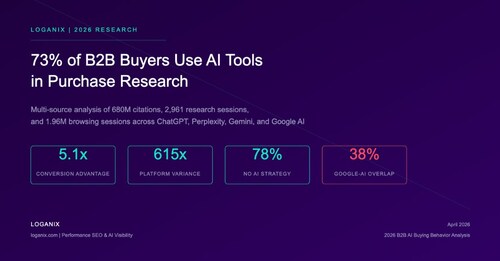
The analysis combined data from six independently published studies conducted between October 2025 and March 2026, covering a combined dataset of 680 million AI citations, 2,961 controlled research sessions, and 1.96 million browsing sessions across ChatGPT, Perplexity, Gemini, and Google AI Overviews.
The headline finding: 73% of B2B buyers now use AI tools like ChatGPT and Perplexity in their research process, according to a March 2026 analysis of 680 million citations by Averi. AI search traffic converts at 14.2% compared to Google organic's 2.8% — a 5.1x advantage — yet only 22% of marketers currently track AI visibility and fewer than 26% plan to develop content specifically for AI citations.
B2B buyer behavior shifted measurably between 2024 and 2026. McKinsey's October 2025 consumer survey found approximately 50% of consumers across all demographics — including boomers — intentionally use AI-powered search for purchasing decisions. Averi's March 2026 analysis of 680 million citations across ChatGPT, Claude, and Google AI confirmed the B2B figure has reached 73%.
Similarweb's 2026 AI Brand Visibility Report found 35% of consumers use AI tools at the discovery and initial ideas stage of research, compared to 13.6% using traditional search at the same stage. For B2B purchases specifically, Forrester's 2025 survey of 4,000+ buyers found 61% of the buying journey completes before the buyer contacts a vendor — a figure that increases when AI tools provide synthesized comparisons that previously required multiple site visits.
AI search traffic converts at 14.2% compared to Google organic's 2.8%, according to Exposure Ninja's March 2026 analysis. The conversion advantage varies by platform: Claude users convert at 16.8%, ChatGPT at 14.2%, and Perplexity at 12.4%. SE Ranking's independent study found AI visitors spend 68% more time on websites than traditional organic visitors. The Washington Post reported AI platform visitors have a 4-5x higher subscription conversion rate versus traditional search, according to Karl Wells, the publication's Chief Revenue Officer.
Table 1: AI search conversion rate by platform
Platform | Conversion Rate | Multiplier vs Google Organic |
Claude | 16.8 % | 6.0x |
ChatGPT | 14.2 % | 5.1x |
Perplexity | 12.4 % | 4.4x |
Google Organic (baseline) | 2.8 % | 1.0x |
Source: Exposure Ninja, March 2026. Platform-specific rates: Fahlout synthesis of multiple sources.
AI search is not a single channel. Citation volumes for the same brand can differ by 615x between platforms, according to Superlines' March 2026 cross-platform analysis. Only 11% of domains are cited by both ChatGPT and Perplexity, per Averi's 680 million citation study. Passionfruit's analysis of 15,000 queries found only 12% of cited sources match across ChatGPT, Perplexity, and Google AI.
The divergence extends to source types. ChatGPT leans on listings for 48.7% of local source citations, while Gemini favors websites at 52.1%. Perplexity diversifies across review platforms and community sources. Reddit accounts for 46.7% of top Perplexity citations but under 10% on ChatGPT following a September 2025 rebalancing. A brand visible on one platform may be entirely absent from another.
Table 2: Cross-platform citation divergence
Metric | Finding | Source |
Cross-platform citation variance | Up to 615x between platforms for same brand | Superlines, Mar 2026 |
Domain overlap (ChatGPT vs Perplexity) | 11% of domains cited by both | Averi, 680M citations |
Source match across 3 platforms | 12% of cited sources shared | Passionfruit, 15K queries |
Google #1 rank to ChatGPT citation overlap | 6.5% URL overlap | Shashko / Bright Data, 42K citations |
Sources as cited. Compiled by Loganix, April 2026.
Despite 73% buyer adoption, marketing teams have not adjusted. Only 22% of marketers currently track AI visibility and traffic. Only 25.7% plan to develop content specifically for AI citations. 64% are unsure how to measure AI search success, according to Yext's 2025 companion report surveying 2,237 adults.
The gap between buyer behavior and marketer response represents a window. 72% of marketing leaders expect AI to surpass SEO as the primary visibility channel within three years, but fewer than one in four have implemented any measurement. Brands that establish AI visibility infrastructure now operate in a market where most competitors have not begun.
Brand web mentions show a Spearman correlation of 0.664 with AI citation rates — approximately three times stronger than the backlink correlation of 0.218, according to an analysis of 75,000 brands by Ahrefs. A separate study from The Digital Bloom analyzing 680 million citations confirmed the same direction. Brand search volume correlates at 0.334 with AI citation — moderate, but substantially weaker than the mention signal.
The implication for B2B marketers is that the signals driving AI visibility differ from those driving traditional search rankings. Link building remains important for search engine rankings that feed AI retrieval systems, but the strongest single predictor of whether a brand appears in AI answers is how frequently that brand is mentioned across authoritative web sources — regardless of whether those mentions include a hyperlink.
The Loganix 2026 B2B AI Buying Behavior Analysis synthesized findings from six independently published studies: Averi (680 million citations, March 2026), SparkToro and Gumshoe.ai (2,961 research sessions across 600 volunteers, January 2026), Previsible (1.96 million browsing sessions, November 2024 through November 2025), Exposure Ninja (conversion rate analysis, March 2026), McKinsey (consumer survey, October 2025), and Yext (2,237 adults, March through April 2025). Platform-specific conversion rates were compiled from a Fahlout synthesis of multiple independent sources. All statistics are attributed to their original published source. Loganix did not conduct primary data collection for this analysis.
B2B buyers use AI search tools to generate shortlists, compare vendors, evaluate pricing, and synthesize reviews — tasks that previously required visiting multiple websites. Averi's 680 million citation analysis found 73% of B2B buyers now incorporate AI tools into their research process. Forrester's survey of 4,000+ buyers found 61% of the purchase journey completes before any vendor contact, a figure AI tools accelerate by providing consolidated comparisons within a single interface.
AI search traffic converts at higher rates because visitors arriving from AI platforms are pre-qualified through the AI's synthesis process. The AI has already filtered options, compared alternatives, and presented a curated recommendation before the user clicks through to the brand's website. Exposure Ninja measured a 14.2% conversion rate for AI-referred traffic versus 2.8% for Google organic — a 5.1x advantage. Claude users showed the highest conversion at 16.8%, likely because Claude cites fewer sources, making each click-through more deliberate.
Brand visibility in AI answers depends on a combination of factors that differ from traditional search rankings. The strongest single predictor is brand mention frequency across authoritative web sources, which correlates at 0.664 with AI citation rates — approximately three times stronger than backlinks at 0.218. Traditional SEO ranking factors explain only 4-7% of AI citation outcomes, according to Profound's analysis of 250 million AI responses. Content structure, freshness, entity density, and multi-platform presence all contribute independently to AI visibility.
Google ranking does not guarantee AI visibility. The overlap between Google's top 10 results and AI citation sources dropped from 76% to 38% in six months, according to Ahrefs' analysis of 863,000 keywords and 4 million AI Overview URLs. ChatGPT shows only 6.5% URL overlap with Google's top 10 results. Perplexity shows 43.5% — the highest alignment. Two out of three AI citations come from pages users would never see on Google's first page.
About Loganix
Loganix is a performance SEO and link building services provider founded in 2010. The company provides white-label and direct SEO solutions to agencies and businesses, including AI visibility measurement and optimization services. Loganix is based in Seattle, Washington. For more information, visit loganix.com.
Contact: Aaron Haynes, CEO
Email: support@loganix.com
Seattle, WA
Photo - https://mma.prnewswire.com/media/2949458/Loganix.jpg

Share this article