Conroy Gold & Natural Resources Plc - Clay Lake Drilling intersects extensive mineralised system
News provided by
Conroy Gold & Natural Resources Plc23 Nov, 2026, 09:00 GMT
23 November 2026
Conroy Gold and Natural Resources plc
("Conroy Gold" or "the Company")
Clay Lake Drilling intersects extensive mineralised system to 400m depth and defines next targets
Conroy Gold (AIM: CGNR), the gold exploration and development company focused on Ireland, is pleased to announce results from its two-hole diamond drilling programme at the Clay Lake gold target, Co. Armagh, Northern Ireland. Holes CGA-26-001 and CGA-26-002 (969.2 m in total) were drilled as step outs about 200 m south-west of CGA-22-005 (40.5 m at 1.2 g/t Au), to test the gold system beyond the previously drilled gold zones. The programme forms part of the Company's work to test the 7.5 km corridor between the Clay Lake gold target and Clontibret gold deposit.
Highlights
· 24 gold zones at or above 0.25 g/t Au intersected in CGA-26-001 and CGA-26-002.
· Broad gold zones encountered in CGA-26-002:
- 26.0 m at 0.36 g/t Au from 322.0 m (0.1 g/t Au cut-off), including:
· 10.0 m at 0.47 g/t Au from 336.0 m
· 10.0 m at 0.39 g/t Au from 323.0 m
- 8.5 m at 0.55 g/t Au from 463.0 m
- 7.0 m at 0.50 g/t Au from 407.0 m, including 1.0 m at 1.75 g/t Au
· Extensive sulphide-bearing system identified in the deepest drilling at Clay Lake to date, extending to about 400 m below surface.
· Higher-grade gold values at the shale contact in CGA-26-001: 2.0 m at 1.17 g/t Au from 331.5 m, including 0.5 m at 3.41 g/t Au.
· Open at depth and to the south-west: alteration continues to the end of CGA-26-002 at 550 m. The size of the alteration and sulphide footprint indicates a large mineralising system.
· Both holes intersected the black carbonaceous shale zone, interpreted to lie within the Orlock Bridge Fault zone.
· Clear follow-up targets identified, including the down-dip extension of CGA-22-005.
John Sherman, Chairman, commented: "This programme has achieved what step-out drilling should: it has shown that the Clay Lake system is substantially larger than the area drilled to date and given us a clear next target below CGA-22-005. With coarse gold also found in streams along the corridor, it strengthens our view that the 7.5 km trend between Clay Lake and Clontibret hosts a gold system along its length."
Results and interpretation
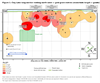
Figure 1 shows the drilling on a long-section. All significant intercepts are set out in Table 1 and broader intercepts in CGA-26-002 at a 0.1 g/t Au cut-off are given in Table 2. The two holes show that the Clay Lake mineralisation system is substantially larger than the area drilled to date. Gold-bearing zones occur over approximately 380 m down-hole in CGA-26-002, and alteration and sulphide mineralisation persist to the end of the hole at 550 m, around 400 m below surface.
Two gold styles are confirmed: gold with arsenopyrite in altered sandstone beside the shale, and gold with pyrite at the shale's upper contact. The higher-grade intercept in CGA-26-001 (2.0 m at 1.17 g/t Au) is of the pyrite style.
Most of the gold in CGA-26-002 is of the arsenopyrite style. CGA-26-001 and CGA-26-002 are the first oriented core drilled at Clay Lake and confirm that bedding strikes 056-061°, consistent with the north-east trend of the Clay Lake gold-in-soil anomaly and Orlock Bridge trend, and gives a firmer basis for targeting.
Next steps
The Company's next steps are, in order:
· Desk and laboratory: rebuild the Clay Lake 3D geological model around the carbonaceous shale, the altered sandstone and the oriented structural data.
· Geophysics: carry out a geophysical programme from CGA-22-005 through the 2026 holes to trace the interpreted Orlock Bridge Fault zone along strike.
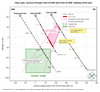
· Drilling: test the down-dip extension of CGA-22-005 (Figure 1 and Figure 2), and continue step-out drilling towards Cargalisgorran, where earlier drilling intersected 6.6 m at 6.2 g/t Au.
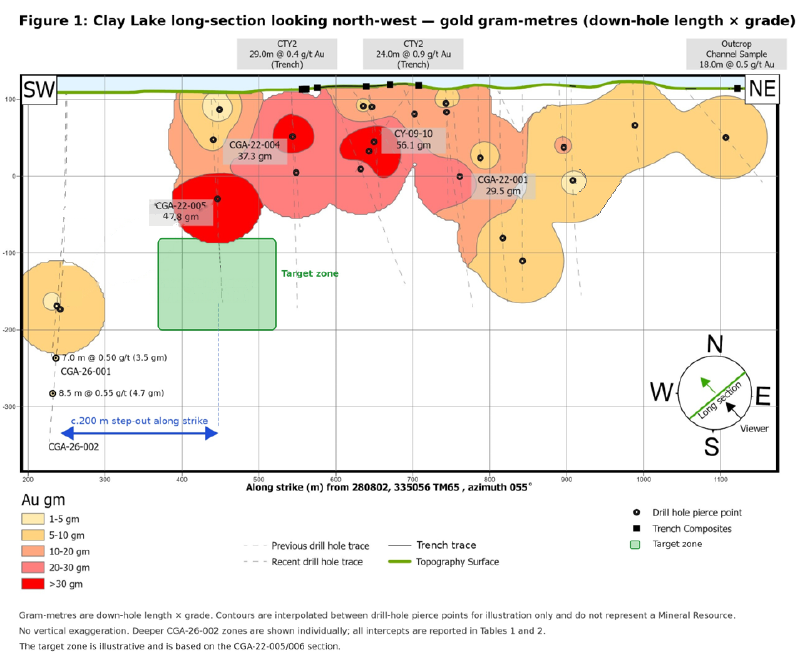
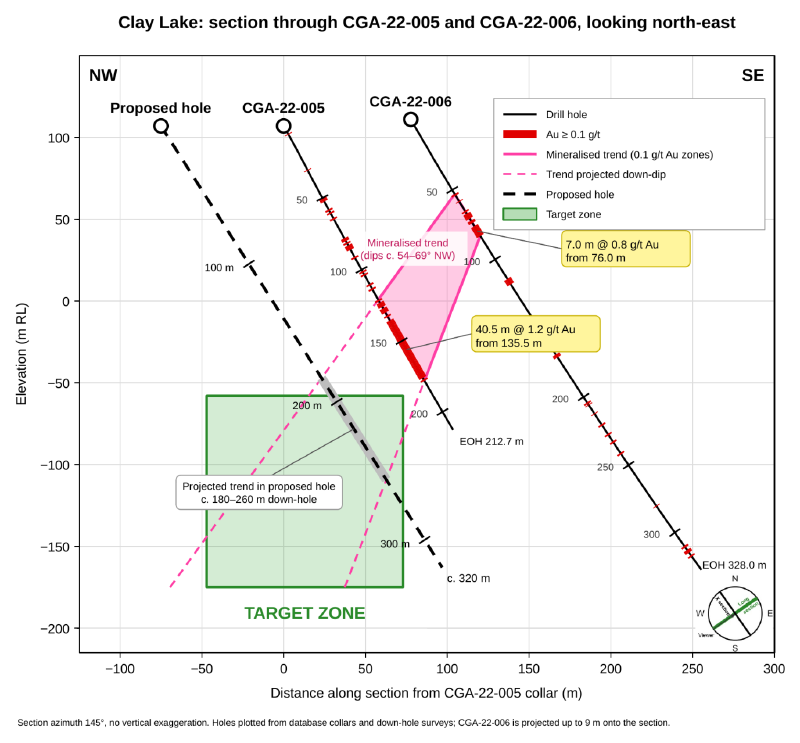
Figure 2: Cross section looking northeast of CGA-22-005 and CGA-22-006 and proposed target zone.
Stream gold study
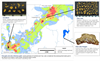
A gold-particle study of stream concentrates that were collected in May 2026 recovered gold grains from a stream in the south-west of the Clay Lake target area, within an existing gold-in-soil anomaly. The grains range from about 100 µm to 1 mm, mostly 300-500 µm, and larger flat grains carry milky quartz in embayments, suggesting vein-hosted gold derived from a nearby source. Coarse, rough gold particles with attached quartz, indicating very limited transport, were also recovered from a stream at Clontibret. The results indicate that coarse free gold occurs along the corridor in addition to the refractory, sulphide-hosted gold at Clontibret and Clay Lake (Figure 3). Stream-concentrate results are qualitative and do not indicate grade; the source areas will be followed up with systematic exploration.
District context and significance.
The Clay Lake gold target lies about 7.5 km north-east of the Company's Clontibret gold deposit, on the Orlock Bridge Fault trend.
A footprint of this size indicates a large gold system capable of hosting further gold zones. The step-out holes intersected the system at depth and along strike from the higher-grade zone in CGA-22-005, and the Company's follow-up work is designed to locate further zones of this kind, starting with the down-dip extension of CGA-22-005 (Figure 2). Together with the coarse gold recovered from streams along the corridor described below, the results support the Company's view that the 7.5 km Clontibret-Clay Lake trend hosts a gold system along its length.
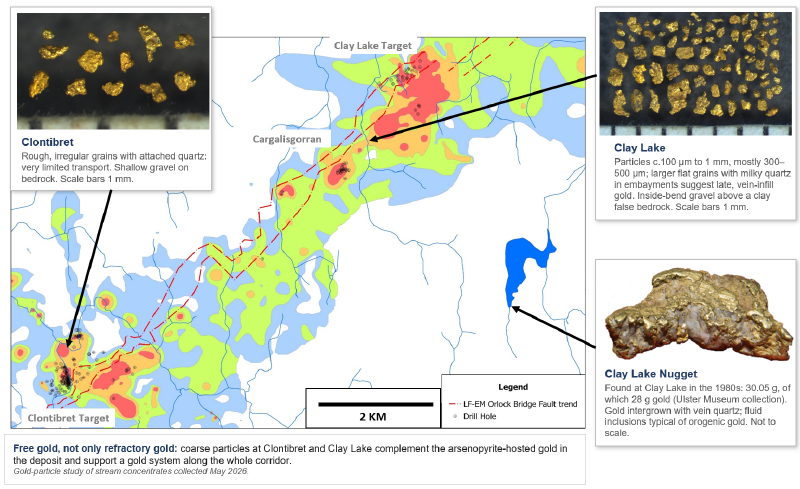
Figure 3: Coarse gold particles from stream concentrates along the Clontibret-Clay Lake corridor (May 2026 study by R. Chapman) and the Clay Lake nugget, on gold-in-soil geochemistry. Stream-concentrate results are qualitative and do not indicate grade.
Table 1: Significant intercepts, CGA-26-001 and CGA-26-002
|
Hole |
From (m) |
To (m) |
Length (m) |
Au (g/t) |
Setting |
|
CGA-26-001 |
96.0 |
97.0 |
1.0 |
0.26 |
Arenite |
|
CGA-26-001 |
202.0 |
203.5 |
1.5 |
0.55 |
Altered arenite |
|
CGA-26-001 |
209.6 |
210.2 |
0.6 |
1.33 |
Altered arenite |
|
CGA-26-001 |
221.5 |
225.5 |
4.0 |
0.54 |
Altered arenite and fault |
|
CGA-26-001 |
289.5 |
290.0 |
0.5 |
0.51 |
Arenite |
|
CGA-26-001 |
323.0 |
323.5 |
0.5 |
0.63 |
Arenite above the shale |
|
CGA-26-001 |
331.5 |
333.5 |
2.0 |
1.17 |
Top of carbonaceous shale; incl. 0.5 m at 3.41 g/t |
|
CGA-26-002 |
153.5 |
154.5 |
1.0 |
0.32 |
Arenite |
|
CGA-26-002 |
180.0 |
182.5 |
2.5 |
0.35 |
Arenite at top of altered zone |
|
CGA-26-002 |
227.0 |
228.0 |
1.0 |
0.45 |
Arenite |
|
CGA-26-002 |
256.0 |
257.0 |
1.0 |
0.99 |
Vein with fibrous sulphide |
|
CGA-26-002 |
323.0 |
333.0 |
10.0 |
0.39 |
Altered arenite |
|
CGA-26-002 |
336.0 |
346.0 |
10.0 |
0.47 |
Re-cemented fault breccia |
|
CGA-26-002 |
356.0 |
357.0 |
1.0 |
0.27 |
Arenite |
|
CGA-26-002 |
365.0 |
365.75 |
0.75 |
0.62 |
Arenite |
|
CGA-26-002 |
376.0 |
378.0 |
2.0 |
0.38 |
Top of carbonaceous shale |
|
CGA-26-002 |
382.0 |
383.0 |
1.0 |
0.29 |
Carbonaceous shale |
|
CGA-26-002 |
387.0 |
388.0 |
1.0 |
0.28 |
Carbonaceous shale |
|
CGA-26-002 |
407.0 |
414.0 |
7.0 |
0.50 |
Arenite below shale; incl. 1.0 m at 1.75 g/t |
|
CGA-26-002 |
463.0 |
471.5 |
8.5 |
0.55 |
Altered arenite; peak 1.37% As |
|
CGA-26-002 |
478.5 |
481.0 |
2.5 |
0.39 |
Fault zone |
|
CGA-26-002 |
494.5 |
496.5 |
2.0 |
0.34 |
Altered arenite |
|
CGA-26-002 |
498.5 |
502.5 |
4.0 |
0.25 |
Altered arenite |
|
CGA-26-002 |
533.0 |
534.0 |
1.0 |
0.67 |
Arenite |
Intercepts: at least 0.25 g/t Au over at least 1 m, length-weighted, with up to 2 m of internal dilution. Zones shorter than 1 m are included where they exceed 0.25 gram-metres. All lengths are down-hole; true widths are not yet established.
Table 2: Broader intercepts, CGA-26-002 (0.1 g/t Au cut-off)
|
Hole |
From (m) |
To (m) |
Length (m) |
Au (g/t) |
Setting |
|
CGA-26-002 |
179.0 |
190.5 |
11.5 |
0.15 |
Arenite, first logged arsenopyrite |
|
CGA-26-002 |
322.0 |
348.0 |
26.0 |
0.36 |
Quartz veins and re-cemented breccia |
|
CGA-26-002 |
375.0 |
389.0 |
14.0 |
0.23 |
Quartz vein and carbonaceous shale |
|
CGA-26-002 |
405.0 |
415.0 |
10.0 |
0.38 |
Arenite/argillite; incl. 1.0 m at 1.75 g/t |
|
CGA-26-002 |
490.4 |
507.5 |
17.1 |
0.16 |
Altered arenite |
Broader intercepts: at least 0.1 g/t Au, above 0.8 gram-metres, shown to illustrate the extent of the gold-bearing envelope; selected intervals of 10 m or more. All lengths are down-hole; true widths are not yet established.
Table 3: Drill collars
|
Hole |
Easting |
Northing |
RL (m) |
Azimuth |
Dip |
Depth (m) |
|
CGA-26-001 |
280946 |
335285 |
109 |
145° |
-60° |
419.2 |
|
CGA-26-002 |
280908 |
335341 |
107 |
145° |
-60° |
550.0 |
Coordinates: Irish Grid. Collar azimuth and dip shown; CGA-26-002 flattened to -53° and swung to 152° by 485 m (EZ-TRAC survey).
Sampling, analysis and quality control
Diamond core (HQ3, reducing to NQ in the lower part of CGA-26-002) was logged and sampled continuously at intervals of 0.3-3.0 m. Half-core samples were submitted to ALS Loughrea, an independent laboratory, where they were crushed to better than 70% passing 2 mm and pulverised to better than 85% passing 75 µm. Gold was determined by 30 g fire assay with ICP-AES finish (Au-ICP21, a total method). Arsenic, antimony and a multi-element suite were determined by four-acid digest with ICP-AES (ME-ICP61, near-total), with arsenic above 1% determined by ore-grade analysis (As-OG46). Conroy Gold inserted certified reference materials (CRMs) and blanks at a combined rate of approximately one in ten samples. All CRM results for gold, arsenic and antimony fell within three standard deviations of their certified values, and no blank exceeded ten times the detection limit. The laboratory's internal standards, blanks and pulp duplicates were also reviewed, and acceptable levels of accuracy and precision were established.
Qualified Person
This release has been approved by Kevin McNulty PGeo, who is a member of the Company's technical staff and holds a BSc/MSc in Geology and Remote Sensing, in accordance with the guidance note for Mining, Oil & Gas Companies issued by the London Stock Exchange in respect of AIM Companies, which outlines standards of disclosure for mineral projects.
For further information please contact:
|
Conroy Gold and Natural Resources plc |
Tel: +353-1-479-6180 |
|
John Sherman, Chairman Maureen Jones, Managing Director |
|
|
Allenby Capital Limited (Nomad) |
Tel: +44-20-3328-5656 |
|
Nick Athanas/Nick Harriss |
|
|
Hybridan LLP (Broker) Claire Louise Noyce Lothbury Financial Services |
Tel: +44-203-764 2341
Tel: +44-20-3290-0707 |
|
Michael Padley |
|
|
Hall Communications |
Tel: +353-1-660-9377 |
|
Don Hall |
|
Visit the website at: www.conroygold.com