Biopharma Companies Must Break the DMTA Linearity, Says Zifo
New position paper calls for Design-Make-Test-Analyse workflows to evolve from linear and sequential processes, into a connected network where scientists can do what they need when they need to, scientific knowledge is captured and context travels with every sample, result, and decision.
CAMBRIDGE, Mass. and CAMBRIDGE, England, Sept. 30, 2026 /PRNewswire/ -- Biopharma companies must break a recurring theme of disconnected experiments, fragmented evidence, manual reconciliation, and repeated context reconstruction that is slowing learning across the scientific value chain, according to Zifo.
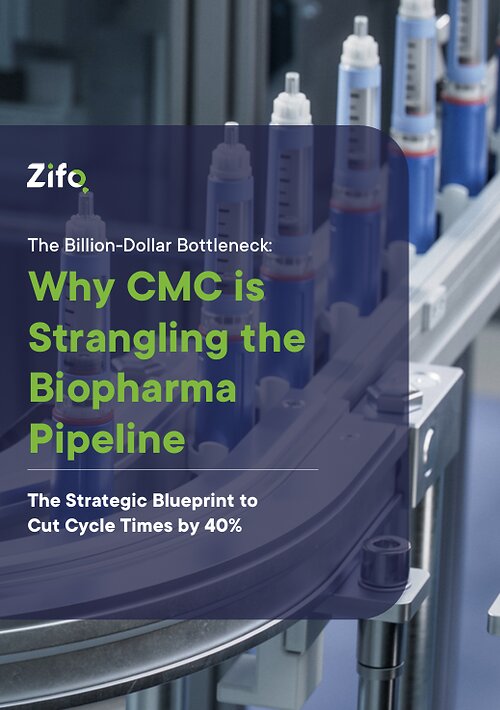
Zifo describes the pattern as the 'DMTA doom loop', a fundamental flaw in the Design-Make-Test-Analyse process in which scientific process is forced into a linear execution model -- rather than adapting and changing based on what is required. In its position paper, The Billion-Dollar Bottleneck: Why CMC Is Strangling the Biopharma Pipeline, Zifo calls for the DMTA process to evolve from a linear sequence of handoffs into a connected scientific network where steps can be done in any order, repeated as required and where the scientific context travels with every sample, result, and decision. https://zifo.com/cmc-million-dollar-bottleneck-biopharma/
When Every Experiment Begins with Reconstruction
Design-Make-Test-Analyse should create an interconnected learning cycle network. Each experimental result should add to the organization's understanding of the relationship between materials, process conditions, equipment, analytical outcomes, product quality, and manufacturing performance.
In many CMC environments, however, evidence is distributed across scientific applications, instruments, spreadsheets, reports, PDFs, batch records, presentations, and individual expertise. Scientists may need to locate data, reconcile sample identifiers, reconstruct experimental histories, and recover the reasoning behind earlier decisions before they can interpret results or design the next experiment.
The position paper argues that the underlying problem is not merely fragmented data. It is the loss of scientific context and decision knowledge as data passes between systems, teams, and lifecycle stages. When results become separated from their samples, methods, process conditions, and decision history, the DMTA cycle may continue operationally but without functioning effectively.
At the core of this broken DMTA process is a failure of scientific user experience. The biopharma industry has often engineered IT ecosystems to satisfy retrospective compliance and data architecture needs, while making the scientist's daily workflow much more difficult. To transform CMC and science, the enterprise must rethink scientific user experience.
Faster Handoffs Do Not Necessarily Create Faster Learning
The position paper cautions against addressing the problem by simply digitizing existing workflows or adding another isolated application.
Moving an inefficient process from paper or spreadsheets into a rigid digital template does not necessarily deliver transformational impacts. It can produce a faster version of the same fragmented process while encouraging scientists to create workarounds outside governed systems.
Breaking the typical sequential process therefore requires more than automating individual steps. It requires reimagining the current DMTA sequential process as an end-to-end scientific workflow into a connected network.
Under the proposed model:
- Scientists and engineers can move and jump between steps as required.
- Relevant historical data and evidence is available when experiments are designed.
- Experimental intent and process context remain connected to samples.
- Test results retain their relationship to methods, conditions, and materials.
- Analytical outputs can be interpreted alongside prior evidence.
- Decisions are captured and remain traceable to the results and reasoning behind them.
- New knowledge becomes available to subsequent experiments and downstream teams.
These principles reflect the paper's proposed shift from isolated systems toward connected scientific context and from a linear baton pass toward an agile DMTA network.
An Orchestration Layer Centered on the Scientist
Rather than proposing a single monolithic platform, the position paper calls for an orchestration layer that connects scientific activity across existing systems of record.
This environment should adapt to scientific process without replacing validated core systems. It should bring together the evidence and context required for a task, allow information to be captured and reused across any step in the DMTA network, and reduce the burden placed on scientists to navigate applications and reconstruct relationships manually.
Reimagining the scientist user experience (UX and UI) means abandoning bloated, all-encompassing rigid linear workflow templates in favor of small, modular, adaptable functional components based on critical capabilities that are adapted to fit the scientists' needs. The scientist requires a digital canvas that supports the immediate workflow in front of them while adapting as their science demands evolve.
The position paper also proposes governed Scientific Language Models (ScLM) grounded in proprietary scientific evidence. Used within a connected and appropriately governed environment, these models could help organizations to capture and interact with their scientific knowledge while maintaining traceability to the underlying evidence.
From Completing Experiments to Compounding Knowledge
A connected DMTA network changes the objective from moving an experiment through separate functional stages to increasing organizational knowledge with every experiment or test.
This requires collaboration across CMC, process development, analytical development, quality, manufacturing, IT, data, and scientific informatics. It also requires organizations to prioritize the scientific and operational choke points where reconnecting evidence and context can produce meaningful value.
The position paper recommends targeted integrations and lighthouse implementations rather than a wholesale replacement of the existing technology estate. This allows organizations to begin with high-value workflows and expand the model within existing brownfield environments.
A scientist should not be forced through every stage if it is scientifically unnecessary. If contextual data already exists in the foundational layer, the researcher could move directly from Design to Analyse. Alternatively, they can move from Analysis into wet-lab execution because the underlying knowledge base is already contextualized and available. This fluidity breaks the linear delay of the traditional value chain and allows scientists to navigate the lifecycle as the biological problem demands.
To download the paper, please click here: https://zifo.com/cmc-million-dollar-bottleneck-biopharma/
About Zifo
Zifo is the leading global enabler of AI and data driven enterprise informatics for science driven organizations. With extensive solutions and services expertise spanning research, development, manufacturing, and clinical domains, we serve a diverse range of industries, including Pharma, Biotech, Chemicals, Food and Beverage, Oil & Gas, and FMCG. Trusted by over 190 science-focused organizations worldwide, Zifo is the partner of choice for advancing digital scientific innovation. https://zifo.com/






Share this article